How to use piRNAome
piRNAome integrates human and other-species piRNAs from seven source databases with verified genomic coordinates, isoform families, clusters, and internal sequence–reference differences. This guide walks through each page and what every panel does.
Quick start — one search box, many ID types
Type any of these into the search bar and press Search. piRNAome resolves the identifier and opens the matching record (or a result list).
- ApiRNA accession or source ID — piRO-hsa-P01780688, piR-hsa-12537, hsa_piR_009086, DQ582314_piR-32426. Common publication spellings such as piR-651 and piRNA-137463 are normalized to their stored source identifiers.
- BGene / TE / miRNA name — CYP4F29P, THE1B-int, hsa-miR-10b-5p
- CCluster or family accession — piRO-hsa-C00014446, piRO-hsa-F00884768
- DRaw sequence (≥8 nt) — CAGCCAACAGGTGTAGAG
Search & entry page
Three zones: filter the collection on the left, read the full record in the middle, and compare every isoform of the family on the right.
The filter rail
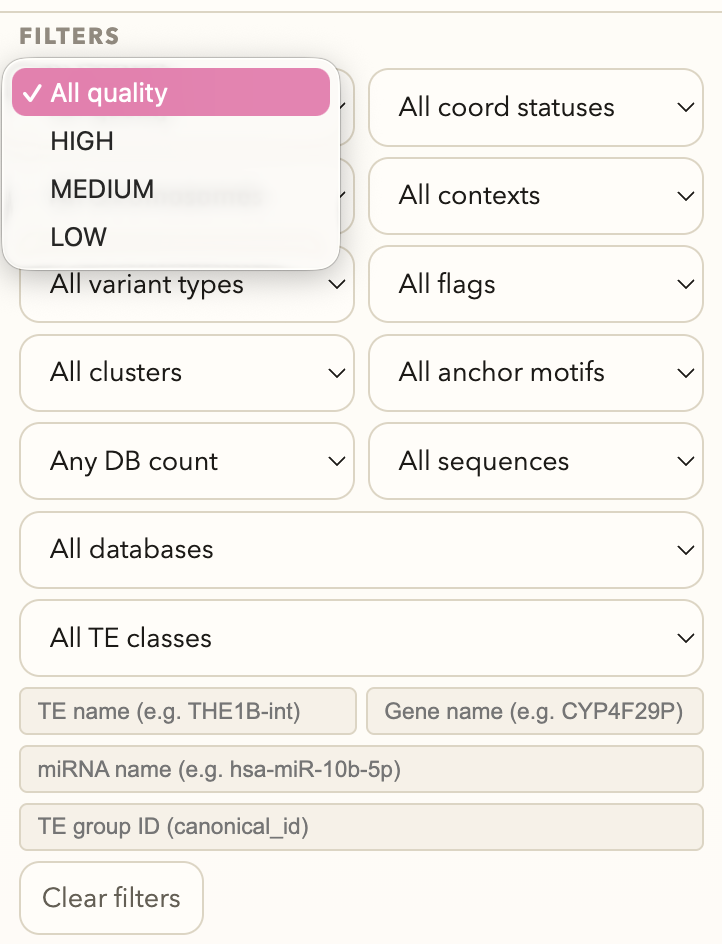
- ·Quality — database support: HIGH (≥3 source DBs) / MEDIUM (2) / LOW (1).
- ·Coordinate status — genome-alignment outcome, including exact match, accepted alignment with an internal difference, coordinate realignment, or no accepted genomic match.
- ·Chromosome — restrict to one chromosome.
- ·Contexts — gene_cds/exon/intron, intergenic, lncRNA, miRNA, transposable_element, pseudogene, …
- ·Variant types — isoform vs. root: root, snv, 5′/3′ ext or trim, and combinations.
- ·Flags — 1U primary, 10A secondary, ping-pong.
- ·Cluster intervals — sourced interval, displayed PICB interval (post-PICB accepted-piRNA-locus enrichment FDR ≤0.05), or unassigned.
- ·Anchor motifs — 1U, 10A, 1U|10A, pyr1, GC_rich, other.
- ·DB count — ≥2 / ≥3 / ≥4 source databases.
- ·Sequences — all, or family roots only.
- ·Databases — a specific source (piRBase, proTRAC, piRNAQuest, NCBI, piRNAdb, piRNABank, piOxiDB).
- ·TE classes — Repbase class/family of the overlapping TE.
- ·Free text — TE name, gene, miRNA, or TE-group ID (exact match).
Reading a record
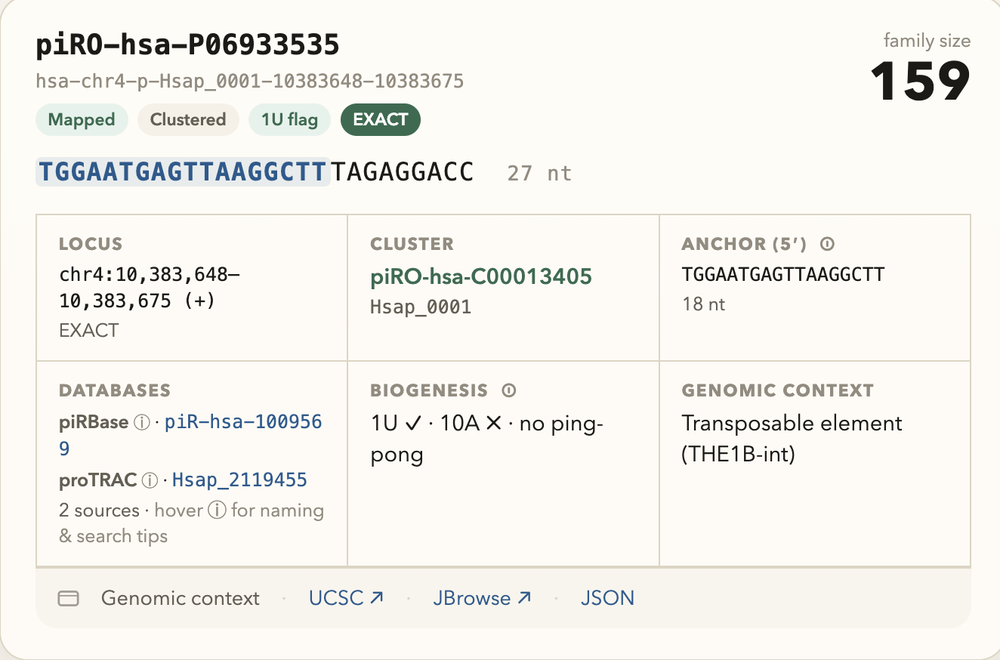
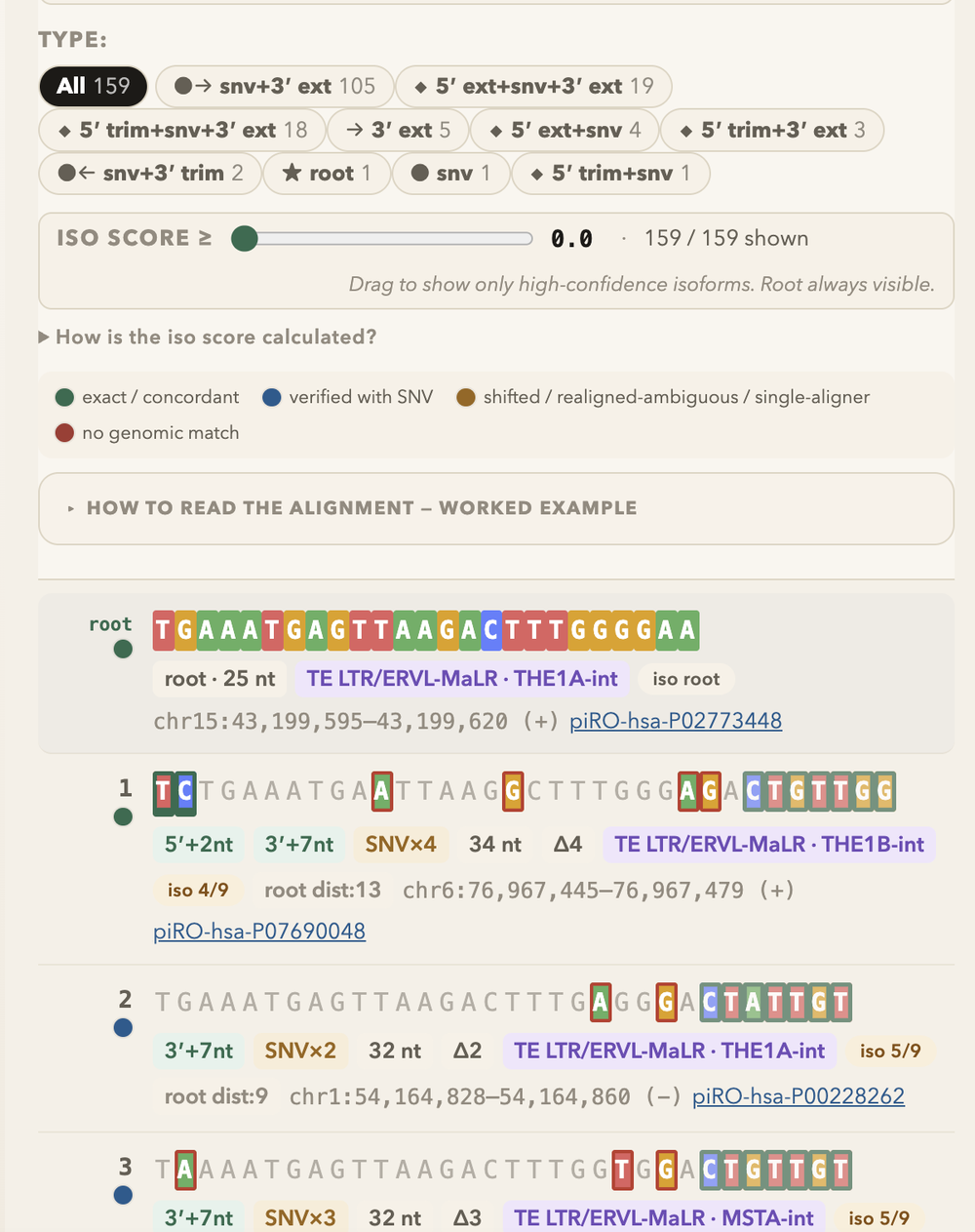
Family alignment & iso-score (right panel)
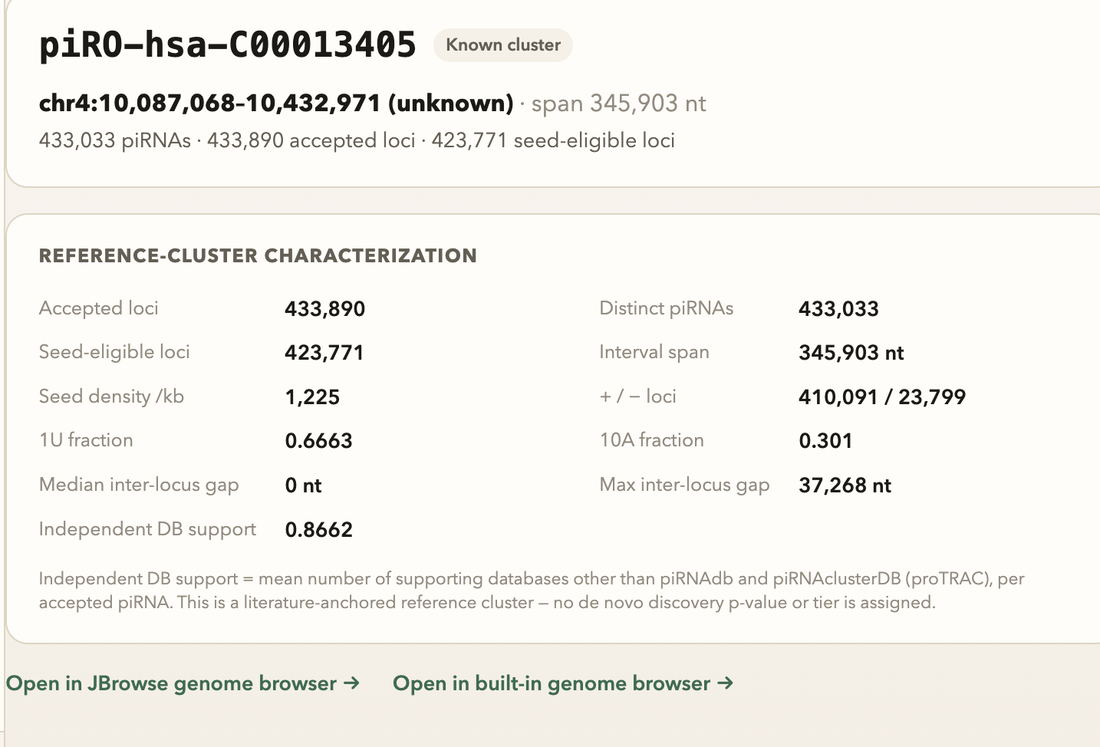
Cluster & family pages
Genome browser
A cluster-oriented browser organised by chromosome. Navigate by coordinates or by piRNA name, and read piRNAs against sourced cluster intervals, PICB-detected intervals with accepted-piRNA-locus enrichment FDR ≤0.05, and adjacent loci assigned to different families.
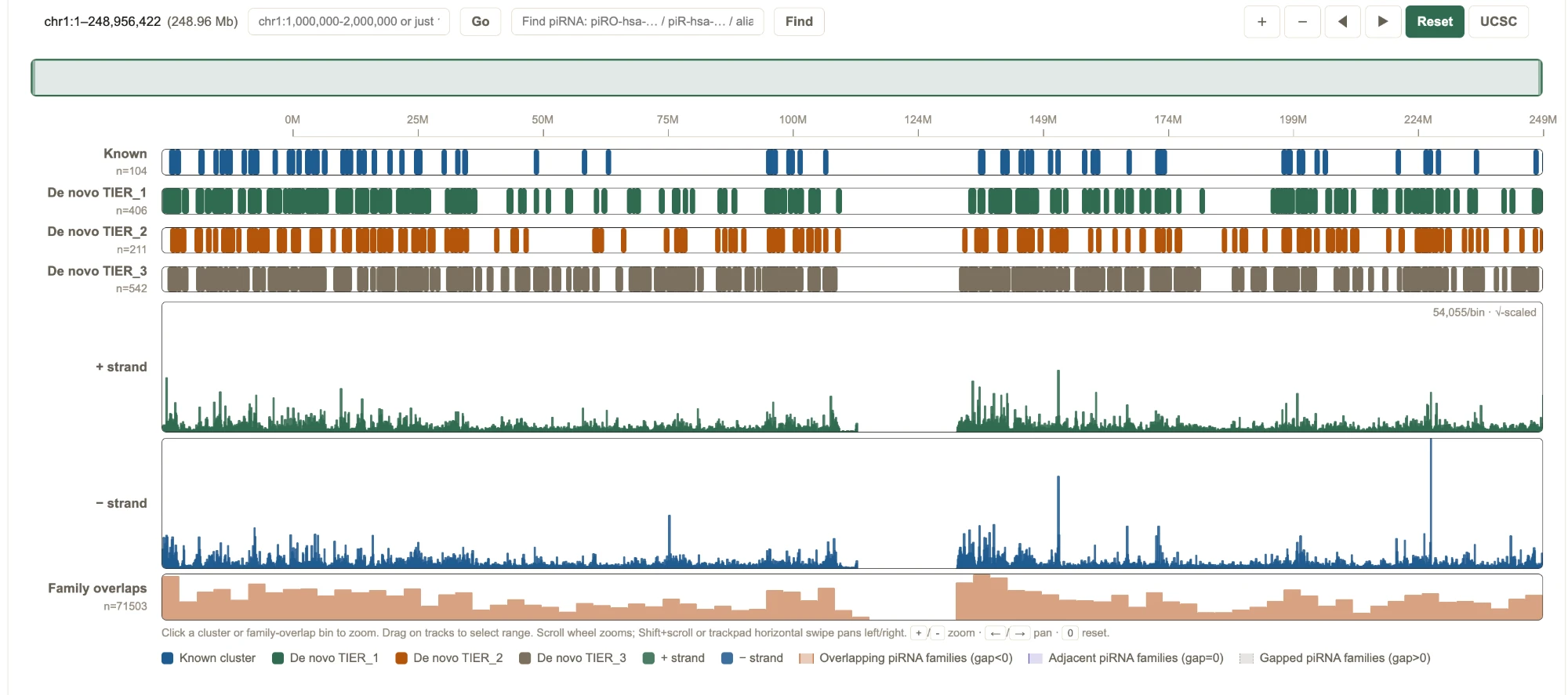
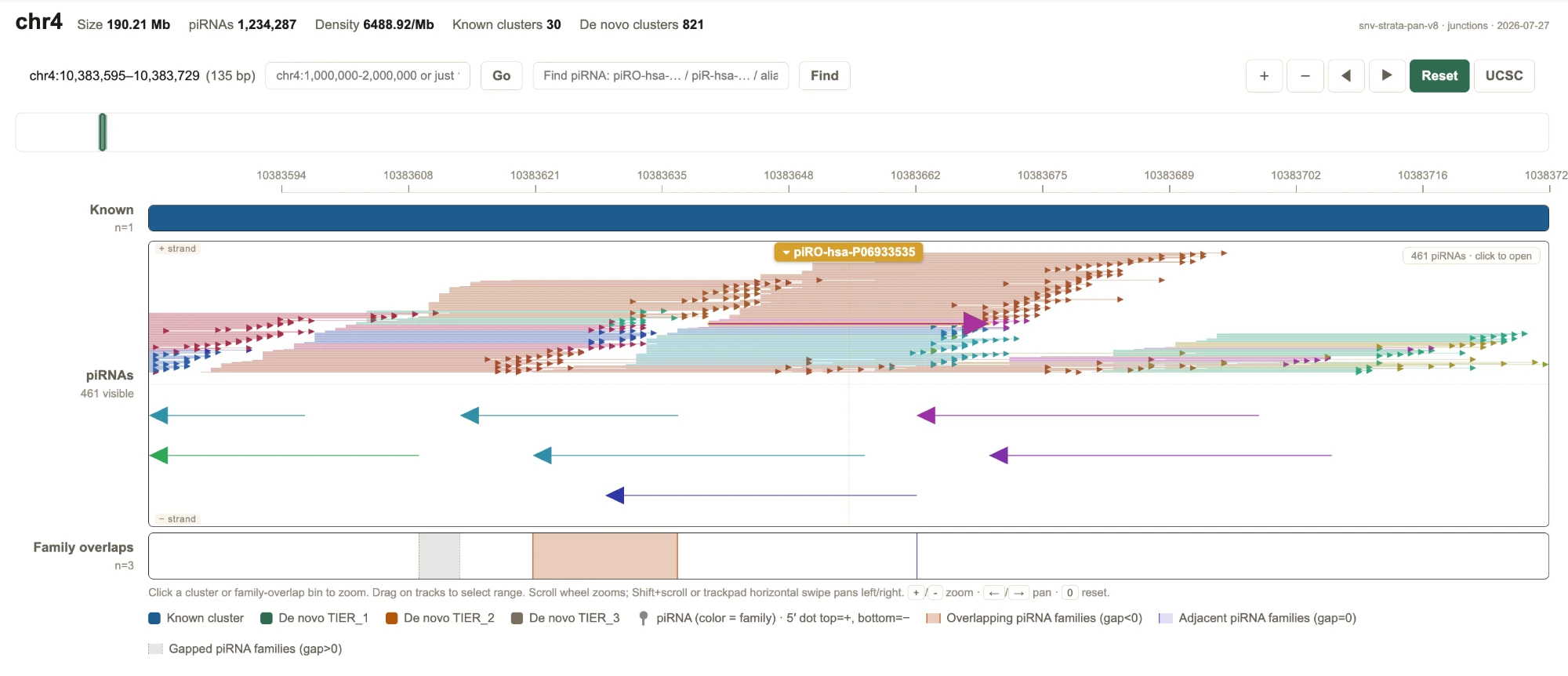
- 1Pick a chromosome from the ideogram (bar height = piRNA density), then zoom/pan.
- 2Two ways to navigate: type coordinates (chr12:9,331,002-9,331,081 or 1.5M), or use Find piRNA — enter an accession/alias and it jumps to that locus and highlights the piRNA.
- 3Tracks: sourced cluster intervals, PICB intervals with FDR ≤0.05, per-strand piRNAs, and adjacent accepted loci assigned to different families. These locus pairs are defined by genomic coordinates and are not direct evidence of an RNA precursor junction.
- 4Cluster list below the density lists every cluster on the chromosome; the ▶ arrow jumps the view to that cluster's span. Dual JBrowse links open the same region.
Internal sequence–reference differences
Browse internal nucleotide differences between mature piRNA sequences and accepted genomic loci. These records are not automatically interpreted as genomic variants.
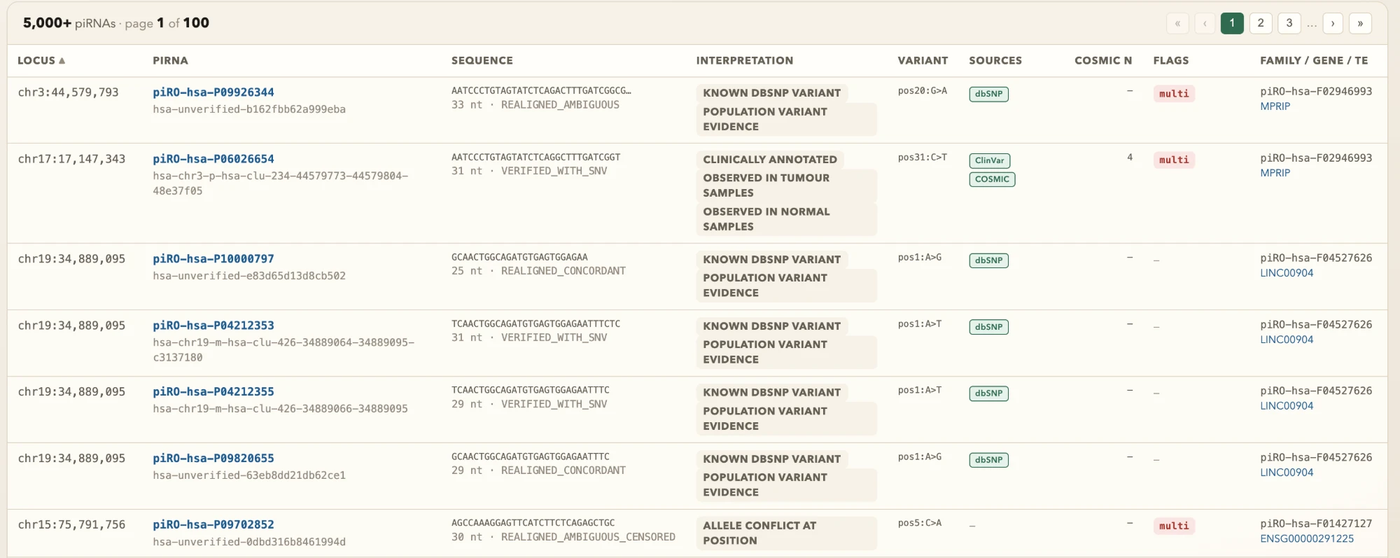
- 1Raw-read filters: show records that passed the read checks, the stricter subset supported in at least two samples, or all catalogue differences.
- 2External databases: filter matches to dbSNP, ClinVar or COSMIC separately from matches to REDIportal RNA-editing sites.
- 3Results. Read counts and q values show what was observed at the assigned locus. Database matches provide a separate annotation and do not by themselves validate the difference.
- 4Back to the record. Click any piRNA to return to the full search / entry page.
Database stats
A one-page overview of what's inside — totals and the contribution of each source database.
- ·Source databases: piRBase, piRNAdb, NCBI, piRNABank, piRNAQuest, piOxiDB, proTRAC — counts and overlap.
- ·Totals: piRNA sequences, piRNA families containing at least two members, sourced cluster intervals, PICB intervals with FDR ≤0.05, adjacent loci assigned to different families, and internal sequence–reference differences. Singleton sequences are reported separately and are not counted as families.
Downloads & API
Every dataset as a flat file, plus a no-authentication REST API.
- ·Data files: piRNA FASTA, genomic GTF, cluster GTF, ID aliases, families, genomic annotation and sequence–reference difference results — each with size, checksum and record count.
- ·Other species: C. elegans, D. melanogaster, M. musculus, R. norvegicus at species.pirnaome.org; per-species CHECKSUMS.
- ·REST API:
/api/entry/{id},/api/search,/api/cluster/{id},/api/snv/search, … (JSON, no auth).